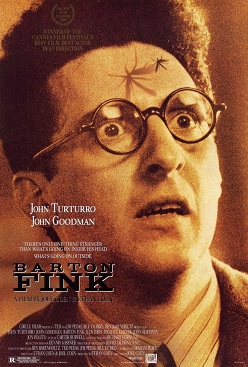
This is, without a doubt, my new favorite Coen Brothers movie. Granted, that's most likely just due to the fact that it's the one I saw most recently. In the past week, I've watched it twice (and I hardly ever feel the need to watch a movie more than once, these days). It's all I can do lately to keep myself from babbling about it, incoherent and enthused, ruining family dinners, birthday parties, and the lives of passers-by in the process. I'm writing this partly in hope of being able to shut the fuck up about it when I'm done. We'll see how that turns out.
When I mentioned this movie to a friend (to Mr. Andrew Kaspereen, as a matter of fact), he said he'd never heard of it. I had never even heard of it myself until recently. This is tragic. In a world where No Country For Old Men sweeps the Oscars, where The Big Lebowski is a de facto religion for a generation of dudes who don't even really grasp the significance of The Dude, where you can pick up 10-dollar copies of Fargo by your grocery checkout stand, it probably qualifies as some kind of Crime Against Humanity.
Because hot damn, son, this is one fine piece of movie.
Barton Fink is made out of things that look like paradoxes. It is the most disturbing comedy and the funniest psychological horror movie I have ever seen. The setup is simple; John Tuturro plays the titular character, a pretentious, neurotic (and successful) Brooklyn playwright with aspirations of creating a new genre of theater 'for the working man.' He holes up in a decomposing old hotel in Los Angeles to write a B wrestling movie, and is completely out of his element, unable to get started. Somehow he ends up making friends with his neighbor in the hotel, a friendly-yet-creepy insurance salesman played by John Goodman. In the meantime, he tries to get advice on writing "wrassling scenarios" from the perpetually drunk W.P. Mayhew (a Faulkner parody), and takes abuse from brusque Hollywood assholes (Tony Shaloub gives a memorably belligerent performance as one of them).
From here, the Coens proceed to risk wrecking the train, packing it full with dark left-turns, throwaway scenes, and oblique symbols, but it never goes off the rails. Instead of becoming a disconnected mess, the movie coheres remarkably well, deftly pursuing a number of thematic dualisms--the body vs. the mind, selfishness vs. empathy, authenticity vs. artifice, and the subconscious links between sex, death, and creativity, to name a few. Did I mention that it's fucking funny?


